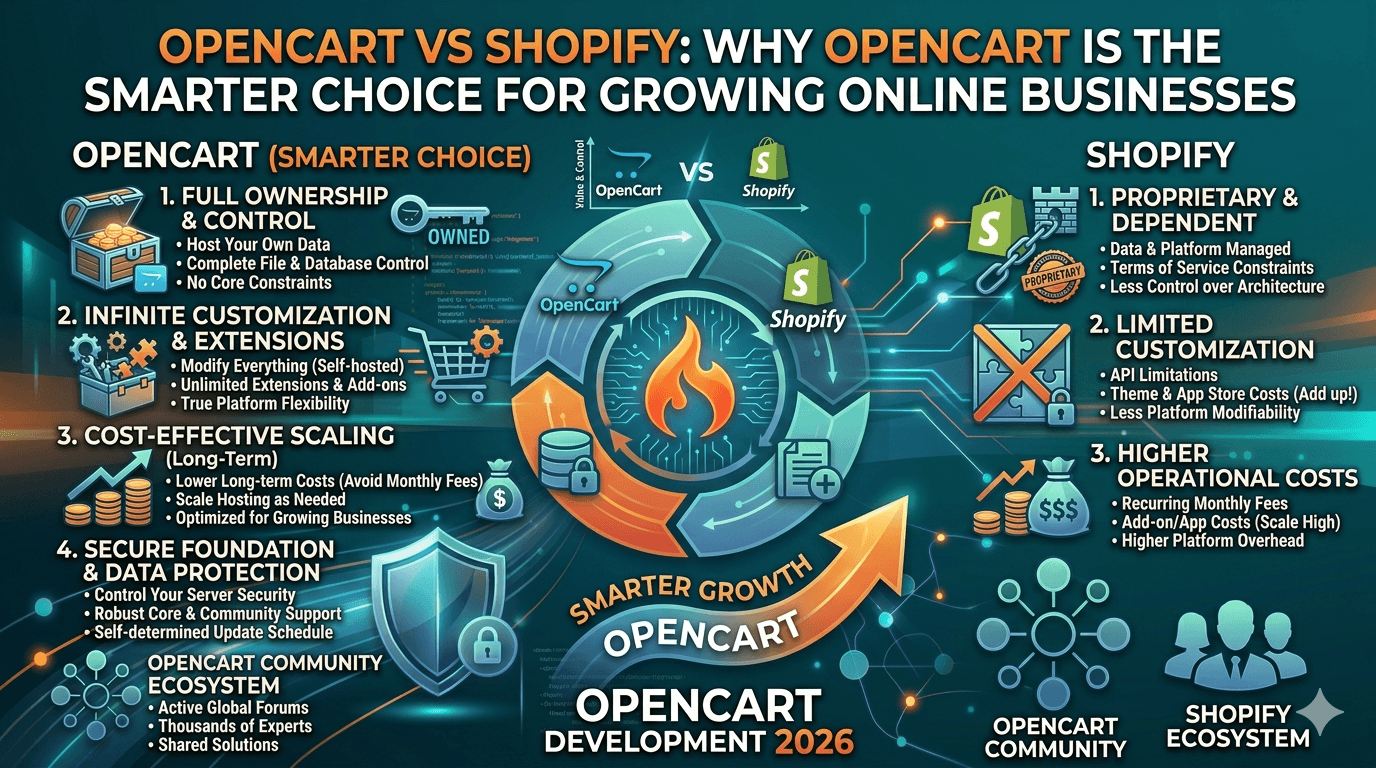
If you are planning to launch or grow an online store, two names come up in almost every conversation: OpenCart and Shopify. Shopify is heavily marketed and has a large user base — but marketing budget is not the same as the best product for your business. After working with dozens of e-commerce stores at Versioning Solutions, we have seen first-hand why OpenCart consistently delivers better results for businesses that want real control, lower long-term costs, and unlimited flexibility.
This is an honest, detailed comparison. We will cover themes, extensions, developer availability, costs, migration, and more — so you can make the right decision with full information.
1. The Core Difference: Freedom vs. a Locked Box
The most important thing to understand before comparing features is the fundamental philosophy of each platform.
OpenCart is open-source software. You download it, install it on your own hosting, and own 100% of the code. You can modify anything — the checkout flow, the product page, the admin panel, the database structure. There are no licensing fees, no monthly subscriptions to the platform itself, and no artificial restrictions on what you can build.
Shopify is a SaaS (Software as a Service) platform. You pay a monthly subscription, and Shopify hosts your store on their servers. This sounds convenient — and it is, at first — but it means you are renting your store. Shopify controls the platform, the updates, the infrastructure, and increasingly, the rules. If Shopify decides to change their pricing, limit a feature, or discontinue a plan, you have very little say in the matter.
With OpenCart, you own your store. With Shopify, you rent it. That single difference affects every decision you will make for your business over the next 5 years.
2. Themes: More Choices, More Control, Less Cost
One of the first things any store owner cares about is how their store looks. Here is how the two platforms compare on themes:
OpenCart Themes
- 500+ themes available across the official OpenCart marketplace, ThemeForest, TemplateMonster, and third-party providers
- Premium themes typically cost ₹3,000 – ₹20,000 (approx. $40 – $250) — one-time payment. You own it forever.
- Popular themes like Journal, Shoppica, Sellya, and Fastor are highly acclaimed for their design quality, speed, and built-in customization panels — no coding required.
- Because OpenCart is open-source, a developer can modify any part of any theme — change the layout, add custom sections, restructure the header, rework the checkout page — with no restrictions.
- ThemeForest alone offers 1,000+ OpenCart themes across every industry: fashion, electronics, furniture, food, jewellery, automotive, and more.
- You can run completely different themes for different stores from the same OpenCart admin panel.
Shopify Themes
- Shopify official theme store offers around 70–100 themes (only 4 are free).
- Premium Shopify themes cost $150 – $350 (approx. ₹12,500 – ₹29,000) — one-time, but customization beyond the theme editor is restricted without Liquid coding knowledge.
- The Shopify theme editor is drag-and-drop but limited to what the theme developer has made configurable. If you want something the theme does not support, you need a developer who knows Liquid — Shopify's proprietary template language.
- Deep customizations still hit a ceiling because Shopify controls the platform.
Verdict — OpenCart wins on themes. More options, lower cost, and a developer can customize every pixel without platform restrictions.
3. Extensions and Apps: 13,000+ vs. 8,000 — and Price Matters More
Every store needs functionality beyond the basics: advanced shipping, loyalty programs, abandoned cart recovery, ERP integrations, invoice generators, B2B pricing, and more.
OpenCart Extensions
- The OpenCart marketplace has over 13,000 extensions — the largest dedicated e-commerce extension library of any open-source platform.
- Most extensions are one-time purchases, typically ₹800 – ₹8,000 ($10 – $100). You pay once, you own it forever.
- Categories include: payment gateways, shipping, SEO tools, product options, loyalty programs, reporting, multi-vendor marketplaces, B2B pricing, ERP integrations, GDPR, and hundreds more.
- Because OpenCart is open-source, developers can also build completely custom extensions for anything the marketplace does not cover.
- Extensions from Indian developers are widely available at prices that make building a feature-rich store very affordable for Indian businesses.
Shopify Apps
- Shopify App Store has around 8,000 apps — fewer than OpenCart.
- Most Shopify apps charge monthly subscriptions. Abandoned cart: $19/month. SEO app: $29/month. Loyalty program: $49/month. B2B pricing: $49/month. Advanced reporting: $79/month.
- A growing Shopify store easily pays $200 – $400/month just in app fees — on top of the Shopify plan.
- Shopify charges transaction fees (0.5% to 2%) on every sale if you use a third-party payment gateway. For Indian stores, Shopify Payments is not available — so every sale through Razorpay, PayU, or CCAvenue is subject to these additional fees.
A store doing ₹2,00,000/month in revenue on Shopify with a 2% transaction fee pays ₹4,000/month — ₹48,000/year — just in transaction fees. On OpenCart, that fee is zero.
Verdict — OpenCart wins on extensions. More extensions, one-time payments, no transaction fees, full customization freedom.
4. Developer Availability: India's PHP Talent Pool Is Unmatched
OpenCart Developers
- OpenCart is built on PHP and MySQL — the most widely known web development stack in India.
- There is a massive pool of OpenCart developers across Ahmedabad, Surat, Bangalore, Mumbai, Delhi, and every other city — at competitive rates.
- Any experienced PHP developer can learn OpenCart quickly. You are never locked into one developer or one agency.
- If you work with Versioning Solutions today, any other PHP developer can continue your project tomorrow — because the code is standard and open.
Shopify Developers
- Shopify requires knowledge of Liquid — Shopify's proprietary template language — plus specific Shopify API patterns. This is a niche skill that fewer developers possess.
- Shopify Plus developers charge premium rates precisely because the skill is specialized and in shorter supply.
- Deeply customized Shopify stores become very expensive to maintain and nearly impossible to migrate away from.
Verdict — OpenCart wins on developer availability. Standard PHP skills, lower rates, more developers, no platform lock-in.
5. Cost Comparison: The True Long-Term Picture
| Cost Item | OpenCart | Shopify |
|---|---|---|
| Platform License | Free | $39 – $399/month |
| Hosting (annual) | $60 – $300/year | Included but no control |
| Theme (one-time) | $40 – $250 | $150 – $350 |
| Extensions / Apps | One-time: $10 – $100 each | Monthly: $20 – $100+ each |
| Transaction Fees | Zero | 0.5% – 2% per sale |
| Multi-Store Support | Free — built in | Requires separate plans |
| Data Ownership | 100% yours | Shopify's servers |
6. Multi-Store Management: OpenCart's Built-In Superpower
If you run or plan to run more than one online store — different product lines, different brands, different countries — OpenCart's native multi-store feature is a game changer.
- From a single OpenCart admin panel, you can manage multiple stores, each with its own domain, theme, product catalogue, pricing, currency, language, and customer base.
- Inventory can be shared across stores or kept separate — completely configurable.
- This is built into OpenCart at no extra cost. On Shopify, each store requires a separate fully-paid subscription.
7. Migration: Moving to OpenCart Is Straightforward
Migrating TO OpenCart
- Established migration tools and services move your store data from Shopify, WooCommerce, Magento, PrestaShop, or a custom platform into OpenCart cleanly.
- Products, categories, customer accounts, order history, and reviews can all be migrated.
- Since OpenCart uses a standard MySQL database, migration is straightforward for an experienced developer — no proprietary data formats to untangle.
- At Versioning Solutions, we handle complete platform migrations with zero data loss, tested on a staging server before the live switch.
Why Businesses Migrate FROM Shopify to OpenCart
- The most common reason: escaping rising monthly costs — Shopify plan increases, app subscription bloat, and transaction fees that eat into margins every single month.
- Shopify exports product and order data as CSV, which maps cleanly into OpenCart with proper handling.
- A well-managed migration typically takes 2–4 weeks including data transfer, theme setup, extension configuration, and testing.
The biggest migration mistake businesses make is waiting too long. Every month on Shopify with rising app fees and transaction costs is money that could have stayed in your business.
8. SEO and Performance
- OpenCart SEO: Full control over URL structure, meta titles, meta descriptions, alt tags, canonical URLs, robots.txt, and sitemap — all without any paid app. With proper hosting and caching, OpenCart stores load very fast.
- Shopify SEO: Built-in basics, but certain URL patterns (like /collections/ and /products/) cannot be changed. Some technical SEO elements need paid apps. Server location and CDN configuration are outside your control.
Final Verdict: OpenCart vs Shopify
| Category | OpenCart | Shopify |
|---|---|---|
| Platform Cost | 🏆 Free | $39–$399/mo |
| Themes Available | 🏆 500+ (one-time) | ~100 (one-time) |
| Extensions / Apps | 🏆 13,000+ one-time | 8,000 monthly fees |
| Transaction Fees | 🏆 Zero | 0.5%–2% per sale |
| Code Ownership | 🏆 100% yours | Shopify's servers |
| Multi-Store | 🏆 Built-in free | Separate paid plans |
| Customisation | 🏆 Unlimited | Platform-restricted |
| Developer Pool | 🏆 Huge (PHP) | Niche (Liquid) |
| SEO Control | 🏆 Full control | Partial control |
| Ease of DIY Setup | Needs developer | 🏆 DIY friendly |
OpenCart wins 9 out of 10 categories for any business serious about growing, controlling costs, and owning their digital storefront. The one area Shopify leads — DIY setup — only matters if you plan to build and manage your store entirely without a developer. For any business that wants a professional, customized, high-performing store, working with an OpenCart specialist gives you far better results than the same budget spent on Shopify.
Ready to Build or Migrate to OpenCart?
At Versioning Solutions, we specialize in OpenCart development across all versions — from OpenCart 1.5 to the latest OpenCart 4.x. Whether you are starting a new store or migrating from Shopify, WooCommerce, or any other platform, we handle the entire process: data migration, theme customization, extension setup, payment gateway integration, and ongoing support.
We have built and customized hundreds of OpenCart stores for clients across India and internationally. Our team is based in Ahmedabad and works with clients worldwide. Contact us today for a free consultation — or request a free project estimate and we will get back to you within 24 hours.